Based TW5 - covering west London Free roof surveys 10 year written guarantee

Common Roof Problems In Hounslow

Spotted something up there and not sure what it means?

The faults west London roofs actually develop, with honest labels for how fast each needs dealing with

Roof worry has a standard opening scene: something catches your eye - a gap in the tiles, a stain, debris on the path - and you have absolutely no framework for whether it's trivial or urgent. This page is the framework. It covers what we keep finding on this patch's housing, from Victorian terraces to last decade's flats, including the one fault that exists almost nowhere else in Britain: tile damage from aircraft wake vortices. Two entries - condensation and gutters - are here because they impersonate expensive roof failures while costing a fraction to fix.

Skip the guessing - book the free survey

Pop your details in and we'll call you back to book the survey. It costs nothing, it obliges you to nothing, and if the honest verdict is that your roof needs no work, that verdict is exactly what you'll get.

10 years

Written workmanship guarantee

Free

Surveys, quotes and second opinions

Same day

Response aim for active leaks

TW5 based

Minutes from most of the patch

Eight faults, honestly ranked

01Tiles on the ground after no obvious weather

Today
What you'll see
A cluster or line of tiles in the garden or on the pavement, a fresh bare patch on one slope - and a forecast that shows nothing that should have caused it.
What's going on
Under the Heathrow approach, think aircraft before you think wind. Wake vortices from landing planes occasionally strike roofs across Cranford, Heston, Hounslow and Isleworth, lifting a concentrated patch of tiles on an otherwise calm day. Elsewhere on the patch, it's usually a fixing that finally let go.
Why it matters
An opened roof takes water and invites the next gust to widen the hole - and if it was a vortex, Heathrow's scheme may owe you the repair, but only if the damage is documented before it's disturbed. Get it made safe and photographed the same day.

02Clay tiles flaking, crumbling or shedding faces

This season
What you'll see
Tiles with their surface peeling off in layers, reddish fragments in the gutters, edges gone rounded and soft-looking on the oldest slopes.
What's going on
Delamination - the interwar clay that roofs most of Heston, Whitton and Feltham has been through ninety-odd winters of freeze and thaw, and frost eventually lifts the fired surface off in leaves. Once the face is gone, the tile drinks water instead of shedding it.
Why it matters
A few delaminated tiles get swapped and the roof carries on for years. A slope where most faces have gone is a roof announcing retirement. The difference is visible from a ladder in minutes, and knowing which you have changes every decision after it.

03A ceiling mark that fades and returns

This month
What you'll see
A tan ring or shadow on an upstairs ceiling that darkens after hard rain and quietly pales during dry spells - easy to stop noticing.
What's going on
A small entry point is wetting the roof timbers with each serious rain, then west London's dry climate - barely 615mm a year out here - dries the evidence before it forces a decision. The mark sits where water ends up, rarely anywhere near where it gets in.
Why it matters
Each cycle leaves the timber wet a little longer, and in a converted loft the water is working behind plasterboard you can't see through. Tracing it now is a modest job; waiting for steady drips means months more soaked timber and a bigger bill for the same fault.

04Damp or staining beside the chimney

Get it surveyed
What you'll see
A wet or discoloured band on the chimney breast wall, in a bedroom or the loft - sometimes with white salts, sometimes a brownish tar tint.
What's going on
The stack is drinking: cracked flaunching at the top, opened joints, a failed flashing where it meets the roof, or rain falling straight down an uncapped dead flue. Decades cold since the gas conversion, it never dries out between soakings.
Why it matters
Wet masonry frosts apart, and chimney repairs are priced by how long they waited - a cap, flaunch and repoint is hundreds; a rebuild is thousands. The brown tinge is old soot migrating through plaster, and it ruins decoration until the source is fixed.

05Gutters overflowing or striping the brickwork

Cheap now, dear later
What you'll see
A curtain of water over the gutter edge in rain, or the tell-tale green-black stripe down an outside wall where overflow has been landing for months.
What's going on
West London's street trees - magnificent, prolific - have dammed the run, or the gutter has sagged off its fall and turned into a trough. On terraces, the blockage is frequently in a neighbour's section of a shared run, which is a diplomatic rather than technical problem.
Why it matters
The cheapest fault on this page and the most expensive one to ignore: a wall that's rained on from its own gutter loses pointing, soaks through, and eventually presents indoors as mystery damp that gets misdiagnosed expensively. Clearing and re-levelling costs lunch money by comparison.

06Standing water on a flat roof

Plan the fix
What you'll see
A pond on the extension, garage or dormer top that's still there two days after rain, ringed by a dirty tide mark showing its regular footprint.
What's going on
The fall has failed - the deck sagged, a joist moved, or the extension builder never gave it enough slope to begin with, a west London tradition of long standing. Water now settles instead of leaving, and summer cloudbursts refill it faster than it evaporates.
Why it matters
No covering is designed to live underwater; the material below a pond ages several times faster than the rest of the roof. It's not tonight's emergency, but re-covering without fixing the fall buys the same failure twice - so plan the proper fix rather than the fourth patch.

07Fine cracks at flashings, or a stack off vertical

Assess, don't panic
What you'll see
Hairline gaps where lead meets brick, mortar cracks around the chimney base, or a stack that looks subtly tilted when you sight up the wall from the garden.
What's going on
Often it's London clay doing what London clay does - swelling in wet winters, shrinking hard in dry summers, and walking the house a millimetre at a time. Roofs and chimneys record the movement at their junctions first. Sometimes it's just Victorian mortar reaching retirement.
Why it matters
Historic, stable movement is normal for this ground and mostly needs the junctions resealing. Active movement is a different conversation - and if the evidence points that way, you need a structural opinion before a roofing invoice. Our survey tells you honestly which story your cracks are telling.

08Wet felt and droplets in the loft, no rain in sight

Fix the airflow
What you'll see
Beads of water on the underside of the felt, damp insulation near the eaves, black mould freckling the timbers - always worst on cold, still mornings.
What's going on
Condensation. The loft's ventilation has been choked - typically by insulation stuffed tight to the eaves or a roofline job that sealed the gaps - so the family's daily moisture rises, hits the cold underside of the roof and rains back down inside.
Why it matters
It imitates a leak well enough that people buy roof repairs that fix nothing. The genuine cure is airflow - vents at the eaves or ridge, insulation pulled back from the edges - and it matters more than it sounds: condensation rots roof timbers just as thoroughly as rain, only quieter.
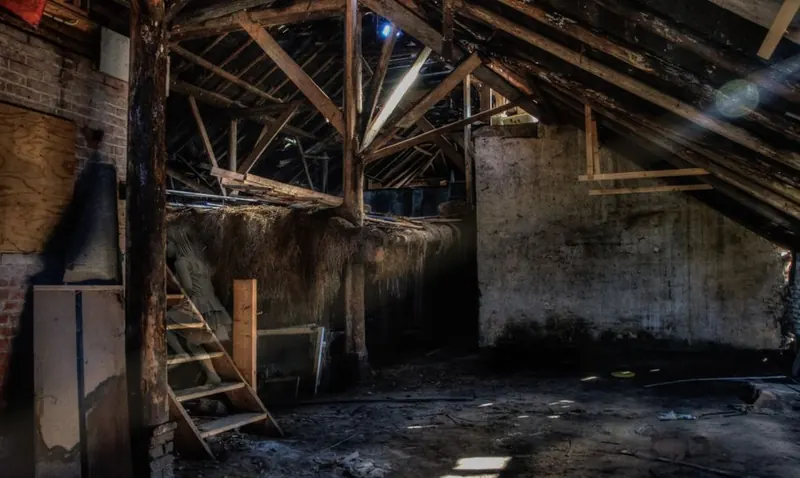
Old roof timbers inside a dark west London loft

The homeowner's check that never leaves the ground

First rule, no exceptions: you don't go on the roof. Not the pitched part, not the flat part, not 'just quickly'. Everything worth knowing can be learned from the pavement, an upstairs window and the loft hatch - which is where these four habits come in.

  • The pavement survey, spring and autumn. Stand across the road and run your eye along the ridge, hips and edges. Photograph the roof each time - your camera roll becomes a free movement detector.
  • The plane-day check. Live under the approach? After any day of unusually low or heavy arrivals, glance over the slopes and the garden. Vortex strikes announce themselves in fallen tiles, and fresh evidence claims better.
  • The dark loft test. Bright day, lights off, patience on. Daylight through the covering is an entry point with an address. A wet-weather repeat with a torch shows you where water actually arrives.
  • The after-storm walk-round. Gutter overflow marks, joints dripping, downpipes discharging against the wall - ten minutes after a downpour catches the cheap problems while they're still cheap.

"Half our job is roofing. The other half is telling west London homeowners which of the things they've been quoted for don't exist."

From the second opinions Watertight Roof Repairs Hounslow provides

Symptom-checker questions

How do I know if my damp is a leak or condensation?

Check what it responds to. Leaks answer to rainfall: a defined wet patch that appears during or straight after rain and sits in one place. Condensation answers to temperature: widespread fine droplets, worst on cold still mornings regardless of weather, usually with black mould for company. If the loft is damp in the middle of a dry, frosty week, the rain has an alibi - and the fix is ventilation, not tiles.

How can I tell vortex damage from ordinary wind damage?

Pattern and timing. A wake vortex strike is concentrated - a cluster or rough line of displaced tiles on one part of one roof, often when neighbouring houses are untouched and the day was calm. Wind damage is messier and arrives with weather everyone remembers, usually worst at ridges, verges and corners across the whole street. If yours looks like the first kind and you're under the approach - Cranford, Heston, Hounslow, Isleworth - photograph everything before touching it and ask us about Heathrow's Vortex Protection Scheme before paying for anything.

Is moss on the roof actually a problem?

Mostly it's a gutter problem wearing a roof costume. Moss thrives on the shaded slopes of west London's tree-lined streets and rarely causes leaks itself - but it sheds constantly into the gutters and builds the dams that cause overflows. Keep the gutters clear, lift heavy cushions of growth if you like, and treat anyone door-knocking about your 'urgent moss situation' as sales theatre, because that's what it is.

Should I get the roof pressure-washed?

We'd talk you out of it. A pressure washer strips the weathered surface from concrete tiles and finishes the job frost started on old clay - effectively fast-forwarding the delamination this page warns about - while driving water up under the laps. If looks matter, gentle manual moss removal and a biocide soft-wash get you there without shortening the roof's life. Most 'roof cleaning' outfits are selling the appearance of maintenance, not the substance.

What can I check myself without getting on a ladder?

Plenty, from three safe places. Street side: sight along the ridge and edges twice a year - straight lines should stay straight, and phone photos make free records to compare. Upstairs windows: after heavy rain, look for gutter overflow and wall staining on your own and facing houses. The loft: on a bright day with the lights off, daylight through the roof is a fault with coordinates; during heavy rain, a torch session shows you exactly where water arrives first. Never go onto the roof itself - that's what our free survey is for.

Someone knocked on the door saying my roof needs urgent work. Do I believe them?

The base rate says no. West London's doorstep roofing trade follows storms and targets older residents, and its script never changes: a problem you can't see, an urgency you can't verify, and a price that needs deciding now. Genuine faults survive a week of thinking. Take a card, close the door, and get an independent opinion - ours are free specifically so that nobody on this patch ever has to take a stranger's word for what's on their own roof.

Straight to the fix: Leaks · Emergencies · Chimneys · Flat roofs

What the patch says about us

Homeowners from Cranford to Hayes on how their jobs actually went.

"Woke up to tiles all over the front garden and not a breath of wind - couldn't work it out. They came the same morning, made it safe, and were the ones who told us it looked like vortex damage from the planes and that Heathrow has a scheme for exactly this. Helped us photograph everything properly for the claim. Could easily have just charged us for a repair and said nothing. That honesty is why I'm writing this."
Sangeeta R. - Cranford
"Our loft conversion started leaking around the dormer two winters after the conversion company vanished. Two roofers quoted big money to strip the whole dormer roof. These guys traced it to one badly-lapped flashing on the cheek, showed me the photo, fixed it in half a day. It's been through every storm since bone dry. The difference was they looked before they priced."
James O. - Isleworth
"Called them expecting to be told the roof needed doing - the house is 1936 and the ridge had been dropping mortar crumbs for a while. Survey verdict: re-bed the ridge, replace five tiles, and the rest is good for years yet. They even marked two tiles to keep an eye on. Quote was a fifth of what I'd braced for. When the roof does eventually need doing, they've earned that job."
Pauline K. - Whitton
"Water started coming through the back bedroom ceiling at 7am on a Sunday. Rang around - one lot quoted a £180 call-out before they'd even start. This firm answered, talked me through switching off the lights circuit and where to put the buckets, and was here by half nine. No weekend premium, made it dry, came back Tuesday and did the proper repair for a very fair price. Kept every promise they made on the phone."
Darren M. - Feltham
"Had the fascias, soffits and gutters done on our terrace. What sold me was the survey - they pushed a screwdriver into the old boards to show me which were actually rotten and which were fine, then quoted to replace only what needed it. Other quotes were for capping over the lot, which they explained the problem with. Work was neat, gutters run properly for the first time in years, and the guarantee arrived as a proper document."
Amrit G. - Hayes

Had us out to your roof?

Two minutes writing a review does more for a small local firm than any advert we could buy - and it helps the next west London household with a drip find someone straight.

Found your fault on the list?

Then you already know more than most people who ring a roofer. The free survey does the rest - confirms it, photographs it, prices it fixed - or tells you the happy version: that what you spotted is nothing, which we deliver just as cheerfully.