
12 October 2026
Emergency Roof Repairs In Hounslow: Your First Moves, Then The Bill
Emergency roof repairs in Hounslow: what to do indoors in the first hour, what a roofer can make safe the same day, local call-out prices and who pays.
Water through a ceiling at eleven at night feels like a disaster. Usually it’s a fixable problem with a fairly predictable price, and what you do in the next hour has more effect on the final bill than anything the roofer does. Emergency roof repairs in Hounslow tend to follow a pattern: a storm that strips tiles across half a street, a still morning when tiles come off one house under the Heathrow approach, or a flat-roofed back extension that finally gives up after a blocked outlet. From our base on Southall Lane, Hounslow, Heston, Cranford, Isleworth and Feltham are usually within a fifteen-minute drive, and a make-safe visit typically lands between £180 and £450. Below is the order we’d tackle it in if it were our own house, starting downstairs.
Emergency roof repairs in Hounslow start indoors, with the fuse board
Before thinking about the roof, think about the electrics. Water travels along joists and cables and often comes out at the nearest light fitting, so a drip from a ceiling rose or a spotlight is the first thing to deal with. Turn that circuit off at the consumer unit. Flicking the wall switch isn’t enough. If the fuse board itself is wet, or you’d have to stand in water to reach it, leave it alone and call an electrician. Don’t use any wet sockets or switches until they’ve been checked.
Next comes the ceiling. Plasterboard soaks up water until it can’t hold any more, then it gives way all at once. If you can see a bulge, keep everyone out of the room, put a bucket under the lowest point and, if you’re confident, make a small hole there with a screwdriver so the water drains into the bucket in a controlled way. That sounds wrong, but a small hole is much cheaper to fix than a collapsed ceiling. Move anything you’d hate to lose, lay towels where the water is spreading, and take photos of it all with the time showing. Then ring us. Our emergency roof repairs page explains how we decide which jobs go to the front of the queue on a busy night.
Why Hounslow roofs give way: storms, aircraft and back extensions
Storms bring in the most calls. London doesn’t get many really damaging winds, but when one comes it finds every tired ridge and loose verge across the borough in a single afternoon. Storm Eunice in February 2022 was the obvious recent case, with the first red wind warning ever issued for London. The Met Office storm centre is worth checking when a named storm is on its way, because the night before is the time to clear gutters and tie down anything loose in the garden.
The second cause belongs to this part of London. Aircraft landing at Heathrow leave wake vortices behind them, and now and then one reaches a roof hard enough to lift a cluster of tiles on a perfectly calm day. If that’s what you’re looking at, don’t pay for the permanent repair yourself until you’ve read our guide to Heathrow wake vortex roof damage, because the airport has its own repair scheme.
The third is the single-storey rear extension found behind thousands of semis and terraces from Hounslow West to Whitton. Their flat roofs fail in a few typical ways: a leaf-blocked outlet turns the roof into a paddling pool, water backs up over the upstand where the roof meets the house wall, or wind lifts a felt lap that was already loose. If the extension roof is old, our article on flat roofs on Hounslow extensions and garages goes through the patch, overlay or rebuild decision.
What we can do the same day, and what we won’t pretend to do
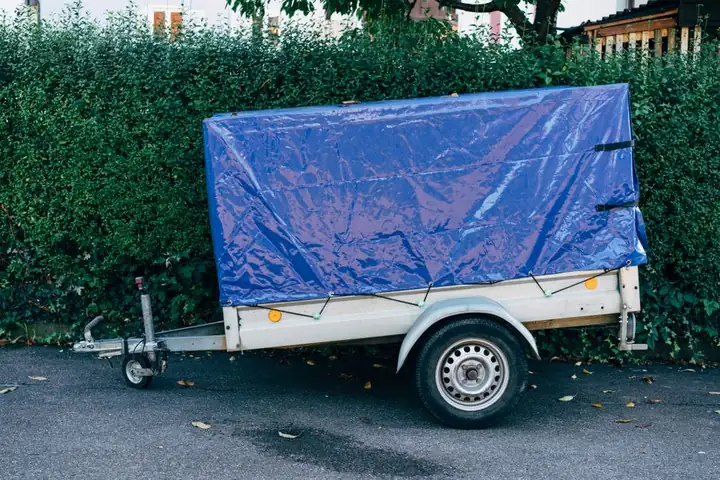
A make-safe has one job: keeping the weather out until a proper repair can be done in daylight. On a pitched roof that usually means a heavy-duty tarpaulin rolled around timber battens at the edges and fixed over the ridge, so the wind can’t get under it. A sheet held down with a couple of bricks will be in next door’s garden by the morning. We’ve retrieved a few. Where a few tiles have slipped and the slope is dry enough to stand on safely, we often refit them on the spot, which can be the whole repair.
On a flat roof, clearing the blocked outlet is often enough to stop the leak, because the water had nowhere to go except into the house. A split in the felt can sometimes take a temporary sealant if we can dry the area, but in steady rain the honest answer is to sheet it and come back. Anything loose that could fall, such as a cracked slate, a sagging length of gutter or a half-detached aerial, comes off or gets secured before we leave.
There are things we won’t do in the dark. That includes rebuilding a chimney, relaying a valley, or quoting for a new roof by torchlight. A roofer who offers to do the whole job tonight for cash is guessing, and you’ll be the one paying for it.
What an emergency roof repair costs in Hounslow
For most households the make-safe visit comes to £180 to £450. The lower end covers refixing a few slipped tiles or clearing an outlet from a ladder, and the upper end covers a large sheet over a stripped slope or anything needing extra hands. A call at 9pm or on a Saturday costs more than the same job on a Tuesday morning, because someone is leaving home to do it, but you hear the out-of-hours rate on the phone before anyone sets off. If a job needs only a short visit, our minimum is roughly £150 to £250, the same as for any other small job.

The permanent repair is priced separately, and the figures on our roof repair cost page apply. A slipped or broken tile refixed or replaced is usually £120 to £280. A leak traced to its source and repaired runs from £180 to £950, depending on how far the water travelled before it showed. A flat roof patch costs £220 to £700, while re-covering an extension roof that is past patching costs £1,700 to £4,800. If scaffold is needed, it appears on its own line at £500 to £1,200 per elevation.
Be wary of any number quoted before someone has looked. “Emergency roofer” searches are full of national call centres that pass your details to whoever pays for the lead, and some charge a call-out fee before anyone has even climbed a ladder.
The permanent repair: why it comes a few days later
People sometimes feel short-changed when the roofer leaves a tarpaulin behind, but the delay is deliberate. Wet battens, a soaked flat roof deck and damp lead won’t take a lasting repair, so a patch put on in the rain will usually fail by the next storm. A day or two of dry weather makes a real difference to how long the fix lasts.
Then there’s sourcing. Many Hounslow houses have clay or concrete tiles that went out of production decades ago, and finding a good match can take a few days of phoning reclamation yards. Access adds time too. On terraced roads where the front wall sits on the pavement, scaffold or a tower on the footway needs a licence from the council, and the London Borough of Hounslow’s highways licence page sets out how to apply. Allow a couple of weeks for that. Indoors, a wet ceiling needs to dry out completely before anyone replasters it or decorates, and that often takes longer than the roof repair does.
Insurers, Heathrow or you: sorting out who pays
There are three possible payers. Storm damage normally goes to your buildings insurer. Verified vortex damage goes to Heathrow’s scheme. Wear and tear, such as crumbling ridge mortar or felt that has simply reached the end of its life, is the homeowner’s own cost. Work out which one you’re dealing with before paying for anything beyond the make-safe.
Most buildings policies expect you to take reasonable steps to stop the damage getting worse, so you don’t need the insurer’s permission to have the roof sheeted. Keep the invoice, keep any broken tiles, and send in the time-stamped photos you took indoors. Whoever does your make-safe should also photograph the roof from up close, since that’s the evidence an assessor will want. Insurers judge storm claims on fairly narrow questions, mostly whether there really were storm conditions and whether the damage fits them, and the Financial Ombudsman Service’s notes on storm damage complaints show how disputes are decided. If you want the full claims process, including what to do after a refusal, our guide to storm damage roof insurance claims in Hounslow covers it step by step.
Water coming in now? Call us or request an emergency visit in Hounslow
Frequently asked questions
Should I go up a ladder and look at the roof myself?
No. A wet roof in the dark is exactly where people get badly hurt, and you can see most of what matters from the ground or from a back bedroom window. Look for gaps in the tile rows, anything hanging off the gutter line and water pooling on a flat roof. Take photos from where you are, then leave the climbing to someone with the right kit and a second person footing the ladder.
How much is an emergency roof call-out in Hounslow?
Our make-safe visits usually come to £180 to £450, depending on how much sheeting is needed and whether we can reach the roof from a ladder. Evenings, weekends and bank holidays carry an out-of-hours charge on top, and we give you the full figure on the phone before we set off. The permanent repair is priced separately once we've had a proper look in daylight.
Can a flat roof on an extension be patched in the rain?
Not properly. Most patch materials need a dry, clean surface to bond, so in steady rain we sheet the damaged area and weigh or batten it down instead, and clear the outlet if a blockage is what caused the flooding. The actual patch or overlay goes on once the roof has dried out, usually within a few days.
Do I need to tell my insurer before I get the roof made safe?
You don't need permission to stop water coming in. Buildings policies generally expect you to take reasonable steps to limit the damage, and a temporary cover is exactly that. Photograph everything before the work, keep the make-safe invoice and any broken tiles, and call your insurer as soon as you can. Wait for them to agree the scope before booking the full permanent repair.
Useful? The survey's even better
Free roof surveys across Hounslow and west London, with photographs and a fixed written quote to follow.