
20 October 2026
Roofers In Hayes And Uxbridge: Hillingdon Semis, Loft Conversions, Conservation Streets And Prices
Need a roofer in Hayes or Uxbridge? How Hillingdon's semis, estates and conservation streets fail, where Heathrow fits in, and what roof repairs cost.
Hayes is the closest town to our base on Southall Lane. In the van it’s about eight minutes away. Uxbridge is the far western edge of what we cover. Both towns come under the London Borough of Hillingdon, which was put together in 1965 and now has 31 conservation areas. That number makes more difference than most people expect when they call a roofer. A slipped tile on a Botwell semi is a ladder job with no forms to fill in. The same tile on a Windsor Street building in Uxbridge is inside a conservation area that dates back to 1973. A hip-to-gable loft conversion that goes through as permitted development in Yeading needs a planning application in Hayes Village. This guide covers how roofs in Hayes and Uxbridge actually fail, what Hillingdon Council wants to see and when, how Heathrow affects you from the north side of the airport, and what we charge.
Hayes, Uxbridge and the Hillingdon boundary
The first thing to settle is which council looks after your house, and around here the postcode won’t always tell you. Hayes is UB3 and UB4 and Uxbridge is mostly UB8 and UB10. Southall is UB1 and UB2, and it’s in Ealing, even though Hayes and Southall run into each other along the Uxbridge Road with nothing to mark the change. UB9 causes the most mix-ups. Harefield is in Hillingdon, but Denham, with the same postcode district, is in Buckinghamshire. When a job needs a planning answer, a building control notice or a scaffold licence, we go by the council named on your council tax bill, not the address on your post. For most jobs we do on roofs in Hayes and Uxbridge, that’s Hillingdon.
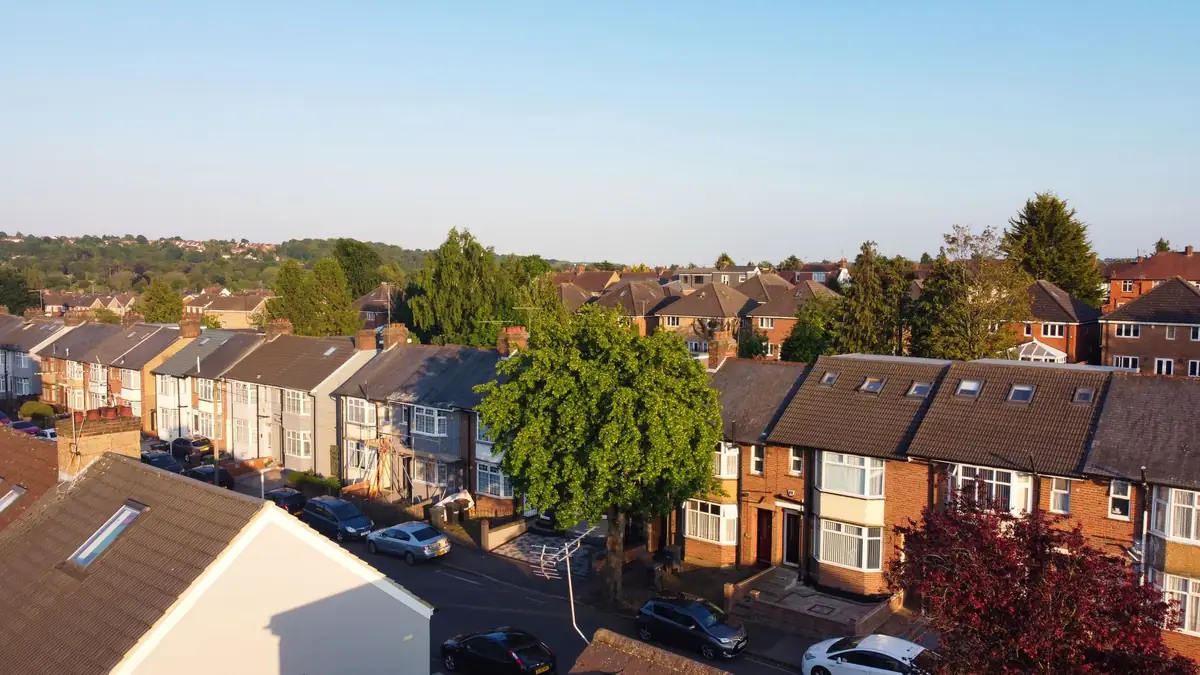
Hillingdon is a big borough, and it reaches from Harefield in the north down to the airport. We don’t cover all of it. We’re based on the Hounslow side, so Hayes, Harlington, Yeading and West Drayton are our nearest Hillingdon areas, and Uxbridge, Cowley and Hillingdon village are about as far west as we go.
Hayes semis and terraces: the loft conversion problem
Most of the roofs we work on in Hayes are on the interwar houses around Botwell, Townfield, Hayes End and Wood End. They’re semis and short terraces built for people who worked in the factories along the canal, and most were given simple hipped roofs with clay or early concrete tiles. On many streets, though, hardly any of those roofs are still in their original form. A lot of Hayes semis have had a hip-to-gable conversion with a box dormer on the back. Those conversions cause a big share of the leaks we’re called out to.
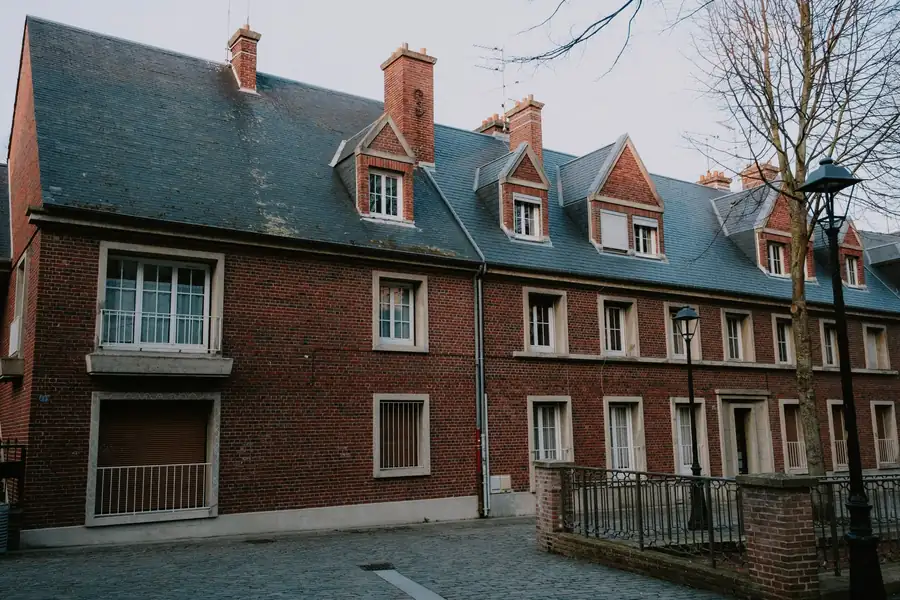
The weak spots are the same from house to house. The first is the joint between the new gable wall and the old roof slope. Often it was finished with a mortar fillet that has since cracked, where a stepped lead flashing should have been used. Adding more mortar on top won’t fix it for long. The fillet has to come out. Next is the party wall. When the house next door still has its hip, there’s an awkward valley or abutment where the two roofs meet, and it has to be weathered properly with lead. Then there’s the dormer. Its flat top was often covered in felt during the conversion and is now ten to twenty years old, and its cheeks may be tile-hung or clad in boards that have been allowed to rot. On top of that, the new slope was rarely tiled to match the 1930s originals, so you end up with two sorts of tile, laid at two different gauges, on one roof.
Hayes also has its postwar estates, and the problem on those is a different one. On a terrace of four, you can find three or four different roofs, because each owner re-roofed when it suited them. You get concrete interlocking tiles next to a newer profile, and the joint between them along the party wall line often isn’t sealed. When a terrace like that leaks, we look along the party walls first. The stacks are often shared on these houses as well, so a repair can need the neighbour’s agreement. Our chimney repairs in Hayes page goes into how we deal with shared stacks.
Uxbridge and Hillingdon: Metroland hips over an older town
Uxbridge grew in two quite separate stages. The Metropolitan line got to the town on 4 July 1904, and in the following decades estates of hip-roofed semis spread out towards Hillingdon, Ickenham and Cowley. These roofs usually have small clay plain tiles, tile-hung bays, deep eaves and bonnet hip tiles, which a pitched roof in Hayes is much less likely to have. A lot of them were built within ten or fifteen years of each other, so they’re wearing out at about the same rate. The iron nails holding the tiles rust through and tiles start to slip in small groups. The mortar under the bonnet hips turns to powder. Bay roofs, which are often finished with lead or a few courses of tile, leak where they meet the front wall.
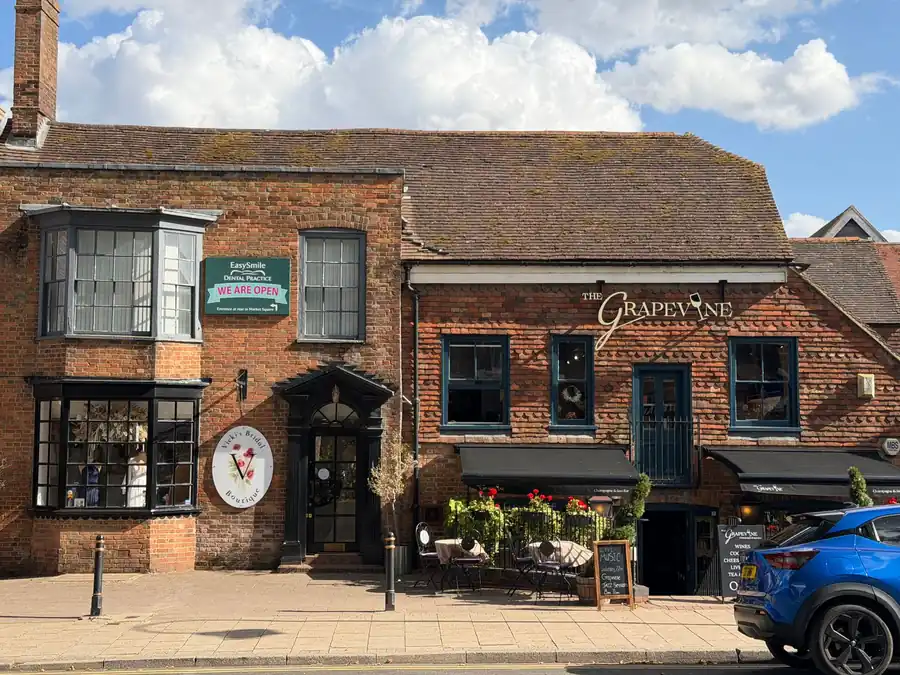
The old market town is still there under the shopping centres. Along Windsor Street and the High Street, near the late 18th-century Market House and St Margaret’s church, the buildings are older and more mixed. Some have slate and some have old handmade clay tile. Several have parapets with lead gutters behind them, and you can’t see the gutters from the pavement. Matching tiles here takes time. A new machine-made clay tile looks out of place next to a weathered handmade one, so on these buildings we look for reclaimed tiles first. The chimneys are taller, and many are more exposed than those on the suburban semis. Our page on chimney repairs in Uxbridge explains how we price that kind of work.
Flat roofs on back additions, garages and dormers
There are flat roofs all over both towns. In Hayes, you’ll find them on rear kitchen extensions, single garages and dormer tops. In Uxbridge, you’ll find them on the side garages of the Metroland semis and on the infill flats near the town centre. Most were covered in felt at some point in the 1980s or 1990s. They tend to fail in a few predictable ways. Puddles form where the deck has sagged and water sits on it. The upstand at the house wall is too short for the job. The felt at the edge trim cracks where the sun hits it hardest.

When the deck underneath is still sound and the problem is in one spot, a patch is the right repair, and it’s usually £220 to £700. When the felt is worn out everywhere, re-covering is better value, and on a typical extension or garage that runs from £1,700 to £4,800 depending on size and whether the boards need replacing. Dormer tops are the awkward ones. You can’t get to them from a ladder, so even a small repair needs a scaffold or a tower, and we put that on the quote as a separate line before we start. For more detail by town, see our pages on flat roof repairs in Hayes and flat roof repairs in Uxbridge.
Heathrow from the north side
Living near Heathrow affects homes in Hayes and Uxbridge in a different way from homes in Hounslow. For about seven days in ten the airport runs westerly operations, which means landing aircraft come in from the east over Hounslow, Heston and Cranford. On easterly days they come in from the Windsor side. Hayes and Uxbridge are north of the airport, so they aren’t on either of those final approach lines. That matters for vortex damage. Heathrow says most strikes happen in small areas close to the runway ends, and those are the only places where it offers blanket protection. Cranford, a mile or so south-east of Hayes, sits right under the approach. Hayes doesn’t.

A strike can still happen up here, though, and Heathrow’s vortex damage repair scheme says any house with a verified strike is eligible. The main thing to remember is not to let anyone repair the roof before Heathrow’s assessor has seen it. Our post on Heathrow wake vortex roof damage explains what a strike looks like on a roof and how to make the claim.
Noise is a separate issue, and it depends on where you live. Harlington, Sipson and Harmondsworth are right up against the northern runway and get far more of it than Hayes town or Uxbridge. Whether a particular house qualifies for Heathrow’s insulation help depends on the scheme boundary, not on how loud it feels in the garden, so check the address on Heathrow’s Quieter Neighbourhood Support postcode checker. What reduces noise coming through a roof is mostly about the loft and the ceiling below it, and our guide to roofs and aircraft noise covers that.
Conservation areas, permitted development and building control
Hillingdon’s conservation areas cover only a small part of Hayes and Uxbridge, but they matter if your house is in one. The ones most relevant to our work are these:
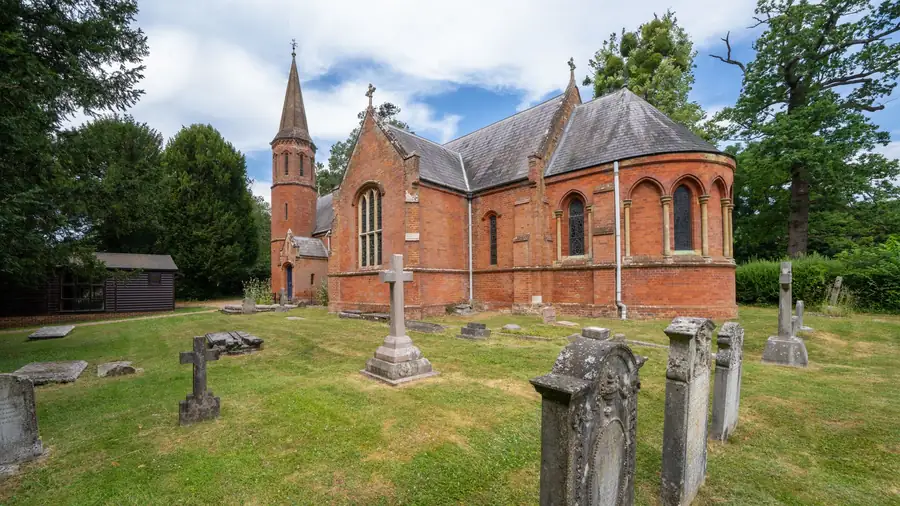
- Old Uxbridge/Windsor Street, which started as the Windsor Street conservation area in 1973 and was joined with Old Uxbridge in 1987.
- Hillingdon Village, designated in 1973.
- Hayes Village, designated in 1970, with its boundary changed in 2015.
- Botwell: Thorn EMI, designated in 1988 and covering the old EMI factory buildings.
- Harlington Village, extended in 2015.
You can find each boundary on Hillingdon Council’s conservation and heritage pages.
Like-for-like repairs are fine in all of them. You can re-bed a ridge, swap broken tiles for matching ones or renew lead in the same way it was done before, and Hillingdon won’t need to hear about it. Things change when you want to alter the roof. Permitted development rights for roof extensions don’t apply in conservation areas, so in Hayes Village or Old Uxbridge a hip-to-gable conversion or rear dormer needs full planning permission. Swapping slate for concrete tile on a building the council considers important is likely to be refused as well.
Building regulations apply everywhere, whether or not you’re in a conservation area. Re-roofing a whole house is building work that has to be notified. If more than half the roof is renewed, the insulation usually has to be brought up to current standards where that’s practical. If the new tiles are much heavier than the old ones, the roof timbers need checking too. We deal with the notification on every full re-roof. The general rules are also covered in our guide to roof work and planning permission.
What roof repairs cost in Hayes and Uxbridge
We charge the same in Hayes and Uxbridge as we do in Hounslow, and there’s no travel supplement for the western end of the area. These are typical ranges from our own quotes:
| Job | Typical price |
|---|---|
| Slipped or broken tile, ladder access | £120 - £280 |
| Leak traced and repaired | £180 - £950 |
| Ridge or hip re-bedded or dry-fixed | £450 - £1,300 |
| Flat roof patch repair | £220 - £700 |
| Garage, extension or dormer flat roof re-covered | £1,700 - £4,800 |
| Chimney repoint, flaunching and cap | £900 - £2,500 |
| Fascias, soffits and gutters renewed | £1,400 - £3,200 |
| Full re-roof on a typical semi | £7,000 - £16,000 |
| Scaffold, per elevation | £500 - £1,200 |
Prices in Hayes and Uxbridge vary more because of how easy the roof is to reach than because of where you live. A loft-converted semi with a dormer at the back usually needs scaffold where a hipped original would only need a ladder. Older buildings near Uxbridge High Street can need a pavement licence before scaffold goes up, and we include that in the price too. If you’d like to compare with what we found further east, we wrote a similar guide for roofers in Isleworth and Osterley.
Every survey is free. You get photos of what we found, a fixed written price and a ten-year guarantee on our workmanship.
Frequently asked questions
Are Hayes and Uxbridge in Hillingdon or Ealing?
Both are in the London Borough of Hillingdon, which was formed in 1965 from Uxbridge, Hayes and Harlington, Ruislip-Northwood and Yiewsley and West Drayton. Southall, right next to Hayes, belongs to Ealing. Watch UB9 addresses too: Harefield is Hillingdon but Denham is in Buckinghamshire. Your council tax bill tells you which council handles any planning or building control on your roof.
Can I do a hip-to-gable loft conversion in Hayes or Uxbridge without planning permission?
On an ordinary house outside a conservation area it can often go ahead as permitted development, subject to the size limits and conditions. Inside any of Hillingdon's conservation areas, including Hayes Village, Botwell: Thorn EMI, Hillingdon Village and Old Uxbridge/Windsor Street, permitted development rights for roof enlargements do not apply, so a hip-to-gable or rear dormer needs a planning application. Building regulations approval is needed either way.
Does the Heathrow vortex scheme cover houses in Hayes and Uxbridge?
Heathrow says any house hit by a verified vortex strike is eligible, wherever it is. Most strikes happen near the runway ends under the landing approach, and Hayes and Uxbridge sit north of the airport rather than under that line, so strikes here are uncommon. If you think one has happened, report it to Heathrow's emergency assessor and do not have the roof repaired before the inspection, or the claim can be refused.
How quickly can you get to a roof leak in Hayes or Uxbridge?
Hayes is about eight minutes from our base on Southall Lane, so an active leak there usually gets a visit the same day. Uxbridge is the western edge of our area and takes longer on the A40, so we give you a realistic arrival time when you ring. Either way the first visit makes the roof watertight, and the written quote for the proper repair follows.
Useful? The survey's even better
Free roof surveys across Hounslow and west London, with photographs and a fixed written quote to follow.